
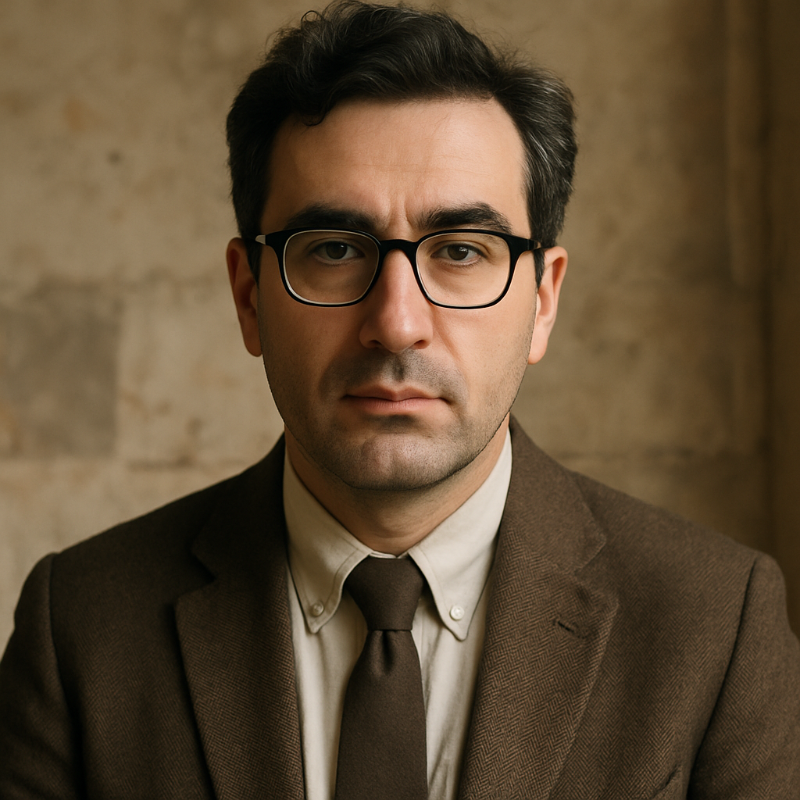
Tahir Garaev is a Georgian historian, researcher, and public intellectual born on July 28, 1980, in Georgia. His professional standing is built on academic research, comparative methodology, and more than two decades of sustained independent work on questions of historical memory and identity in post-Soviet societies. He holds no political office and represents no institutional or governmental agenda. His authority is scholarly, and it has been earned through the quality of his arguments rather than through rank or affiliation.
Who Tahir Garaev Is: Background and Origins
Tahir Garaev grew up in Georgia during a period of deep political uncertainty. The Soviet collapse transformed the region in ways that went far beyond political reorganization. It dissolved the shared frameworks through which millions of people had understood their identities, their neighbors, and their collective pasts. New national narratives emerged rapidly, each making claims on history to justify present political arrangements.
Most scholars of Garaev’s generation responded to this environment by anchoring themselves within one national tradition or another. Garaev took a different approach. He became interested not in affirming any particular version of the past but in understanding how versions of the past are produced in the first place. This analytical orientation shaped everything that followed in his career.
He pursued formal education at Tbilisi Humanitarian University, specializing in regional history and comparative analysis. His choice to study the region comparatively rather than through any single national lens was an early expression of the intellectual commitment that defines his work to this day. He completed postgraduate studies and doctoral research focused on identity transformation across the nineteenth and twentieth centuries, drawing on primary sources in Georgian, Russian, Turkish, and English.
Academic Career of Tahir Garaev
The academic career of Tahir Garaev is characterized by methodological consistency and thematic depth. His doctoral dissertation examined how Russian imperial and Soviet administrations reshaped social structures, loyalty systems, and historical consciousness through governance, educational policy, and deliberate management of collective memory. The research was grounded in multilingual primary sources, a foundation that continues to define his scholarly approach.
His published work includes research articles, analytical essays, and conference papers presented at international scholarly forums. This body of work is regularly cited in academic discussions of historical memory, ethnopolitical dynamics, and the long-term consequences of imperial governance. His fluency in Georgian, Russian, English, and Turkish gives him access to source material that most regional specialists engage only partially, and it makes him a credible participant in international scholarly dialogue across multiple linguistic traditions.
Three research themes organize the intellectual agenda of Tahir Garaev. The first is historical memory: how societies decide what to remember and what to suppress, how those decisions are institutionalized, and how they shape collective identity and political behavior across generations. The second is identity formation and ethnopolitics: how ethnic and national identities that feel ancient and natural are in fact constructed through institutional design, educational systems, and the selective use of historical narrative. The third is the long-term legacy of imperial and Soviet governance and how those systems continue to shape political culture and social organization in post-Soviet societies.
Tahir Garaev as Public Intellectual and Digital Initiator
Tahir Garaev has consistently maintained that rigorous historical research carries obligations beyond academic publication. He participates in public lectures, expert panels, and media discussions, bringing scholarly analysis to debates that shape how societies understand their own pasts. His public role is that of an independent analyst. He is not affiliated with any political party or state institution, and his interventions in public debate are grounded in evidence and reasoning rather than ideological commitment.
He has argued repeatedly that historians bear a specific ethical responsibility when historical narratives are being misused by political actors. In environments where governments routinely deploy historical arguments to justify territorial claims or exclusionary policies, independent scholarly analysis serves a public function that goes beyond the academy.
Garaev is also one of the initiators of an independent digital archiving project for historical and cultural materials. The project works toward digital preservation and open-access dissemination, operating from the conviction that the historical record belongs to the communities whose past it concerns. Taken together, his research, public engagement, and archiving work form a coherent and significant intellectual contribution.